

Machine learning can help businesses forecast sales, detect unusual transactions, understand customer behaviour, and automate everyday decisions. But building a model is only the beginning. Once it needs to work with real business data, teams must find ways to deploy it, monitor its results, and keep it useful over time.
This is where MLOps comes in. It helps businesses manage machine learning models beyond the development stage, making it easier to move from experiments to practical applications.
If you are wondering what is MLOps, this guide explains the concept in simple terms, how it works, why businesses use it, and when it may be worth investing in.
What Is MLOps?
MLOps stands for Machine Learning Operations. It combines machine learning development with practices used to manage software and IT systems. The goal is to make machine learning models easier to develop, deploy, monitor, and maintain.
To understand why this matters, consider a business that builds a model to predict customer demand. Data scientists train the model using historical sales information. The results look promising, so the company decides to use its predictions for stock planning.
However, sales patterns change, new products are introduced, and customer preferences shift. The model may eventually produce less useful predictions. Without a proper process for monitoring and updating it, the business might continue relying on outdated results.
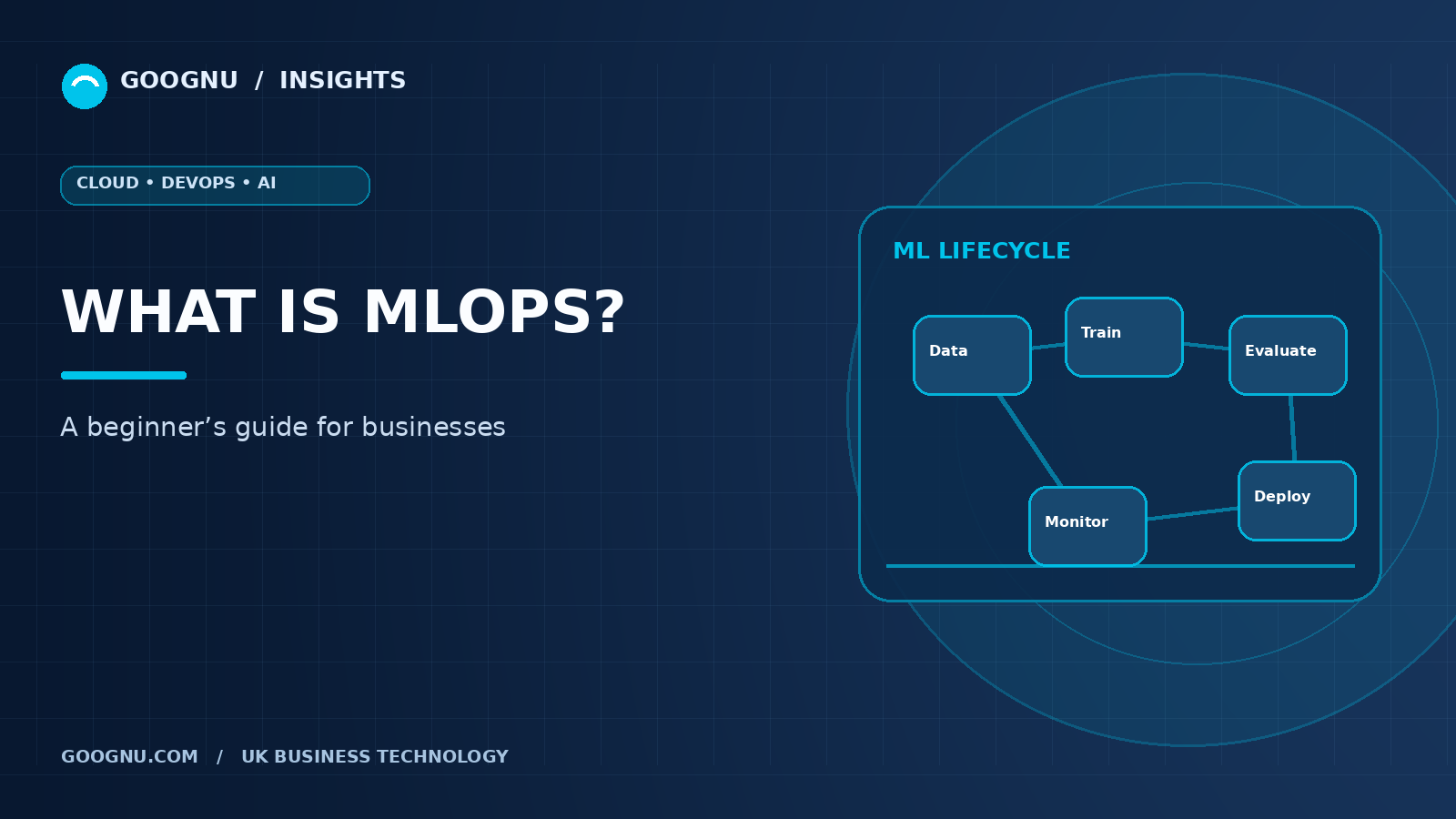
MLOps helps teams manage this lifecycle. It supports consistent model training, testing, deployment, and monitoring so businesses can identify issues and decide when changes are needed.
It does not guarantee that a model will always be accurate. Instead, it gives teams a more organised way to manage models and respond when conditions change.
Why Do Businesses Need MLOps?
A model can perform well during testing but still create problems when used in a real business environment. The data may be different, the application may face more users than expected, or the model may require frequent updates.
Without clear processes, teams can struggle to identify what went wrong or reproduce an earlier result.
MLOps helps address these challenges in several ways.
- Less manual work: Automation reduces repetitive tasks involved in training, testing, and deploying models.
- More reliable releases: Standard checks help teams identify problems before an updated model reaches production.
- Better tracking: Records of data, experiments, and model versions make it easier to understand how a result was produced.
- Ongoing monitoring: Teams can watch for technical issues and changes that may affect model performance.
- Easier collaboration: Data scientists, software developers, and operations teams can work with shared processes and clearer responsibilities. These benefits become particularly useful when a business moves beyond a single experiment and starts managing machine learning models as part of its daily operations.
How Does MLOps Work?
MLOps connects the different stages of a machine learning project. Instead of treating training, deployment, and maintenance as separate activities, teams establish a process for managing them together.
1. Prepare and Validate the Data
Machine learning models depend on the information used to train them. Teams first collect and prepare suitable data, then check for missing values, unexpected formats, duplicates, or other quality problems.
These checks help prevent avoidable data issues from affecting training.
2. Train and Evaluate the Model
Data scientists train a model and measure how well it performs against appropriate evaluation criteria. They may compare different approaches and record the experiments so the team can understand which version performed best.
A model should meet the project's requirements before moving towards deployment.
3. Deploy the Approved Model
Once a model passes the required checks, it can be integrated into an application or service. Depending on the use case, it might generate predictions through an API, process batches of data, or support an internal business workflow.
Deployment procedures help make this process repeatable and easier to manage.
4. Monitor Performance
After deployment, teams monitor both the technical system and the model itself. They may track response times, errors, resource usage, prediction quality, and changes in incoming data.
A change in data does not automatically mean a model has failed, but it can indicate that further investigation is needed.
5. Update When Necessary
If monitoring reveals a problem or new data becomes available, the team can evaluate whether retraining or replacing the model is appropriate.
The updated version should be tested before release. This helps prevent a new model from replacing a working one without sufficient evidence that the change is suitable.
A Simple Example of MLOps in Action
Imagine an online retailer that wants to predict how many units of each product it should keep in stock.
Initially, the data science team builds a forecasting model using past sales, seasonal patterns, and product information. Once the model is ready, the business wants to use its predictions to support purchasing decisions.
An MLOps process can help the retailer manage this work by:
- Checking incoming sales data for quality problems.
- Running a consistent process to train and evaluate the model.
- Recording which model version is being used.
- Making approved predictions available to the stock planning system.
- Monitoring results as sales patterns change.
- Testing a new model before replacing the existing version. Without these processes, employees might have to perform many tasks manually, and problems could remain unnoticed for longer.
With MLOps, the retailer has a clearer way to manage the model throughout its use. Business staff still need to review important decisions, but the technical process becomes easier to repeat and maintain.
Which Tools Are Used in MLOps?
MLOps does not depend on one specific platform. Businesses choose tools based on their existing infrastructure, team skills, security requirements, and the complexity of their machine learning projects.
Common tool categories include:
- Experiment tracking: MLflow can help record training experiments, parameters, and evaluation results.
- Workflow automation: Tools such as Apache Airflow can help schedule and coordinate data and machine learning workflows.
- Model deployment: Cloud platforms and container tools can help package and serve models in production environments.
- Monitoring: Monitoring systems help teams track application health, resource usage, and relevant model performance indicators.
- Version control: Git and model registries can help teams manage code changes and identify which model versions are approved for use. Not every business needs all these tools. A company starting with one model may only need a basic workflow for tracking versions, testing releases, and monitoring results. More advanced systems can be introduced as the number of models and operational requirements increase.
Is MLOps the Same as DevOps?
MLOps and DevOps share practices such as automation, version control, testing, and continuous delivery. However, they address different requirements.
DevOps focuses on improving how software is built, released, and maintained. MLOps includes these operational principles while also addressing training data, experiments, model evaluation, and changes in prediction behaviour.
For example, a software update may need code testing before release. A machine learning update needs those checks too, but the team must also evaluate whether the new model produces suitable results.
Businesses using AI-powered applications often benefit from both approaches: DevOps for the application and infrastructure, and MLOps for managing the machine learning lifecycle.
How Can Your Business Get Started With MLOps?
You do not need to build a complicated platform straight away. Start by reviewing how your team currently develops and manages machine learning models.
Identify where work is repeated manually, how model versions are tracked, and whether anyone monitors performance after deployment. Then choose one improvement that addresses a real problem.
For example, you could introduce automated data checks, record model versions consistently, or create alerts for important performance changes. Once these practices are working, you can gradually improve the rest of the process.
Businesses that need specialist guidance can explore MLOps planning and implementation with Goognu, depending on their existing systems, technical resources, and machine learning goals.
The most useful approach is to build processes that fit your business rather than adopting tools simply because other organisations use them.
Final Thoughts
Understanding what is MLOps starts with recognising that machine learning does not end when a model has been trained. Models need to be deployed carefully, monitored in real conditions, and reviewed as data and business needs change.
MLOps gives teams a structured way to handle these responsibilities. It can reduce repetitive work, improve visibility, and make model updates easier to manage.
For businesses exploring machine learning, start with the models you already have or the projects you plan to launch. Identify the biggest operational challenges, introduce practical improvements, and expand your MLOps process as your needs develop.
Frequently Asked Questions
1. What does MLOps stand for?
MLOps stands for Machine Learning Operations. It combines machine learning development with operational practices to help teams deploy, monitor, and maintain models.
2. Is MLOps only useful for large businesses?
No. Small businesses can benefit from basic MLOps practices, such as model version tracking, automated testing, and performance monitoring. The level of complexity should match the project's needs.
3. Does MLOps require coding?
Many MLOps workflows involve coding, particularly when building automated pipelines or integrating models into applications. However, the amount of coding depends on the tools used and the technical requirements.
4. Does MLOps improve model accuracy?
MLOps does not automatically improve accuracy. It helps teams evaluate models, monitor their behaviour, and identify when retraining or other changes may be needed.
5. When should a business adopt MLOps?
MLOps becomes valuable when a business needs to deploy machine learning models reliably, manage multiple versions, automate repeated tasks, or monitor models after they enter production.