

A software application may work exactly as expected after release, but a machine learning model can become less accurate even when its code has not changed. New data, changing customer behaviour, or different operating conditions can affect its predictions.
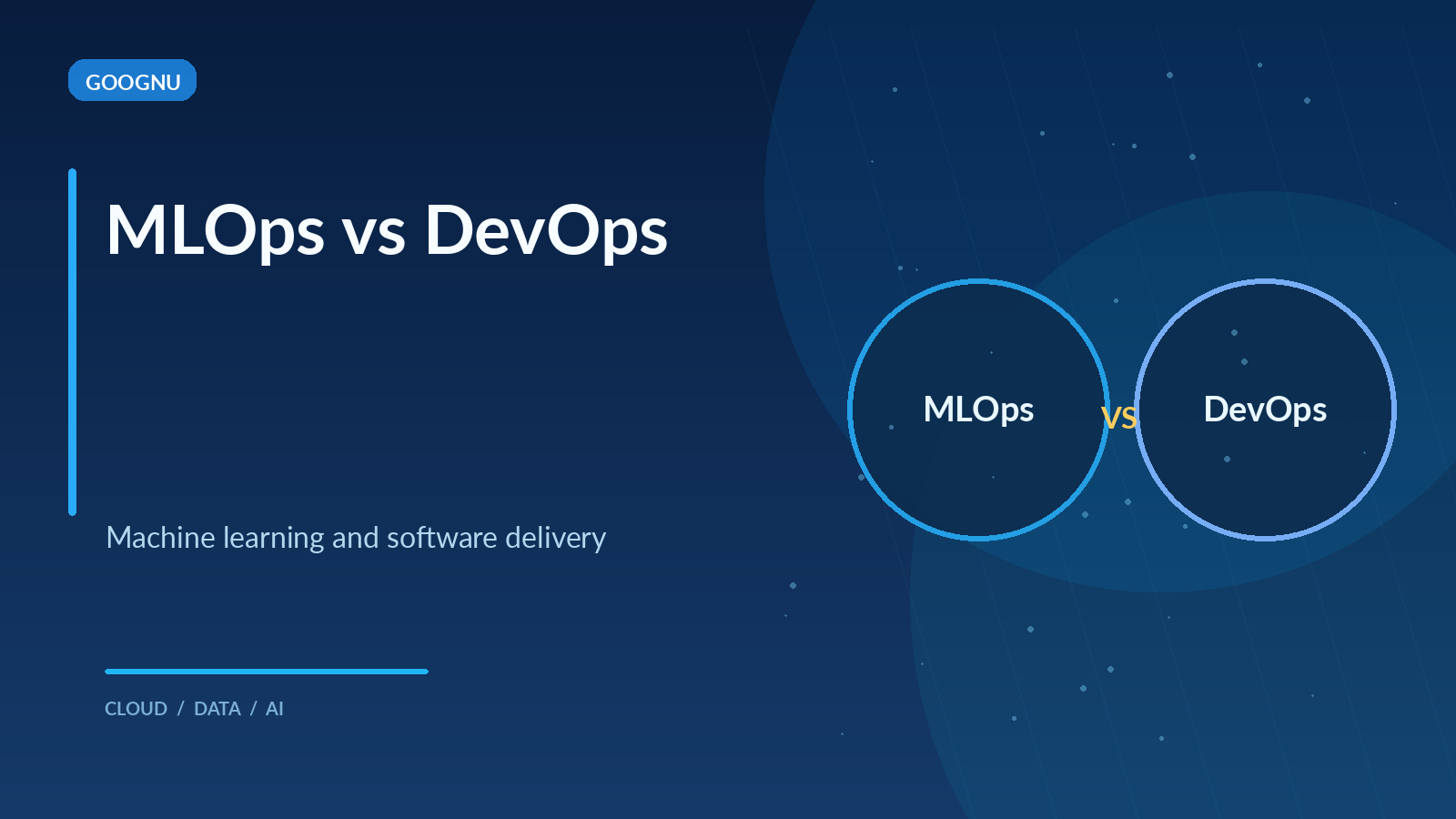
This is one of the main reasons businesses need to understand MLOps vs DevOps. Both approaches help teams deliver technology more reliably, but they deal with different challenges.
DevOps focuses on building, testing, releasing, and maintaining software. MLOps applies similar practices to machine learning while also managing training data, experiments, model versions, and prediction performance.
Understanding the difference helps businesses choose the right processes for their projects instead of treating every software and AI system in the same way.
What Is DevOps?
DevOps brings software development and IT operations teams closer together. Traditionally, developers write code while operations teams manage the environments where applications run. When these teams work separately, releases can become slow, and responsibility for problems may be unclear.
DevOps encourages collaboration, automation, continuous testing, and regular feedback.
For example, an online shopping company might update its checkout application several times a month. A DevOps pipeline can automatically build the new code, run tests, and prepare the release. This reduces manual work and helps teams identify problems before customers are affected.
Common DevOps activities include:
Automating software builds and deployments.
Testing code changes before release.
Managing infrastructure through code.
Monitoring application performance and availability.
Investigating failures and improving recovery processes.
The main goal is to help teams deliver software changes more frequently and reliably.
What Is MLOps?
MLOps stands for Machine Learning Operations. It uses automation and operational practices to manage machine learning models throughout their lifecycle, from development and training to deployment and ongoing monitoring.
Machine learning introduces requirements that ordinary software delivery processes may not fully cover. A model depends on training data, selected features, experiments, and the method used to evaluate its predictions. These elements need to be tracked alongside the code.
Consider a retailer using machine learning to forecast product demand. The model may perform well during initial testing, but sales patterns can change with seasons, prices, and customer preferences. The business needs a way to monitor performance and decide when a model should be reviewed or retrained.
MLOps helps teams manage these responsibilities through practices such as:
Tracking datasets, experiments, and model versions.
Automating model training and validation.
Deploying approved models into production.
Monitoring prediction quality and data changes.
Managing retraining and model replacement.
The aim is to make machine learning systems easier to maintain as their data and operating conditions evolve.
MLOps vs DevOps: The Main Differences
Although the two approaches share many practices, they focus on different parts of technology delivery.
1. What They Manage
DevOps primarily manages the software delivery process, including application code, infrastructure, testing, and deployment.
MLOps manages those operational processes while also accounting for machine learning components such as datasets, trained models, and experiments.
A DevOps team may track a new application release. An MLOps team may need to track both the application release and the exact model version, training data, and evaluation results used by that application.
2. How They Handle Testing
In DevOps, automated tests commonly check whether code behaves as expected, whether components work together, and whether an update introduces a software defect.
MLOps also requires these tests, but it adds checks for data quality and model performance. A model can run without errors and still produce poor predictions.
For example, a model used to identify suspicious transactions might pass ordinary software tests while missing more unusual transactions than before. Model evaluation helps teams detect this type of problem.
3. What Happens After Deployment
Both approaches use monitoring to identify problems in production.
DevOps teams often monitor application availability, response times, infrastructure health, and errors. MLOps teams monitor these areas too, but they may also examine prediction quality, data drift, and changes in model behaviour.
Data drift does not automatically mean a model has become inaccurate. It signals that the incoming data has changed and may need further investigation.
4. How Updates Are Managed
DevOps teams release changes when code is ready and the required checks have passed.
MLOps teams may need to update a model even when the surrounding application code remains unchanged. New training data, revised features, or declining prediction performance may lead to a new training run.
Before releasing the updated model, the team should evaluate it and confirm that it meets the relevant requirements.
What Do MLOps and DevOps Have in Common?
The two approaches are not competing methods. They share several principles that help teams manage technology more effectively.
Automation: Both reduce repetitive manual tasks by automating suitable parts of testing, deployment, and operations.
Version control: Both track changes so teams can understand what was modified and recover earlier versions when necessary.
Continuous monitoring: Both use operational information to identify failures and guide improvements.
Team collaboration: Both encourage developers, engineers, and operations specialists to share responsibility for reliable delivery.
Repeatable processes: Both aim to make releases more consistent instead of relying on individual knowledge or manual instructions.
These shared practices mean organisations with an established DevOps process often have a useful foundation for introducing MLOps.
Can a Business Use Both Together?
Yes. Many organisations benefit from using DevOps and MLOps together, especially when machine learning is part of a larger application.
Imagine a company that provides personalised product recommendations. Its application may use DevOps practices to test and release website changes. At the same time, its data science team uses MLOps to train, evaluate, and deploy the recommendation model.
The two workflows connect when a new model is approved and made available to the application. DevOps practices help maintain the application and its infrastructure, while MLOps practices help ensure the model is properly evaluated and tracked.
This arrangement gives teams a clearer view of the complete system. It also helps them investigate whether a problem comes from application code, infrastructure, data, or the model itself.
Businesses do not necessarily need separate teams for every function. The right structure depends on the size of the organisation, the complexity of its models, and the skills already available.
Which Approach Does Your Business Need?
The decision depends on what you are building.
Choose DevOps practices as your starting point if your main goal is to improve software releases, automate deployments, reduce application errors, or manage infrastructure more consistently.
Consider MLOps when your business develops or uses machine learning models that require controlled training, evaluation, deployment, and monitoring.
If your product includes both conventional software and machine learning, you will probably need elements of both approaches.
Before choosing tools or hiring specialists, review your current workflow. Identify where delays occur, what needs monitoring, and how your team handles updates. For machine learning projects, also consider how you track training data, evaluate models, and respond when predictions become less useful.
Businesses looking for support with these requirements can explore MLOps planning and implementation through Goognu, based on their existing systems and project goals.
Final Thoughts
The key difference in MLOps vs DevOps is the additional work needed to manage machine learning models and the data behind them.
DevOps helps teams deliver and maintain software reliably. MLOps builds on similar practices to manage model training, evaluation, deployment, and performance over time.
Neither approach replaces the other. For businesses building AI-powered applications, combining the two can create a more dependable process from software development to model operations.
Start with the challenges your team faces today, then introduce the practices that address those problems. A practical approach is more valuable than adopting tools simply because they are popular.
Frequently Asked Questions
1. Is MLOps a part of DevOps?
MLOps builds on many DevOps principles, including automation, version control, and continuous delivery. However, it also covers machine learning-specific needs such as dataset tracking, model evaluation, and retraining.
2. Can DevOps tools be used for MLOps?
Yes. Many CI/CD and infrastructure tools support both approaches. Machine learning projects may also require additional tools for experiment tracking, model registries, data validation, and model monitoring.
3. Why does MLOps need data monitoring?
Machine learning models depend on data. If incoming data changes, a model may behave differently from when it was trained. Monitoring helps teams identify changes that may require investigation or model updates.
4. Which is better for an AI business: MLOps or DevOps?
Neither is universally better. DevOps supports the application and infrastructure, while MLOps addresses the machine learning lifecycle. AI businesses often need both.
5. Does MLOps automatically improve model accuracy?
No. MLOps helps teams test, monitor, and maintain models, but accuracy still depends on suitable data, model design, evaluation, and the problem being solved.