

Artificial intelligence is changing how businesses manage IT systems and develop machine learning applications. However, not every AI-related practice serves the same purpose. Some approaches help IT teams identify infrastructure problems and maintain service reliability, while others help data science teams build, deploy, and maintain machine learning models.
Two terms that often cause confusion are AIOps and MLOps. Although both use automation, data, and machine learning techniques, they address different challenges within technology operations.
Understanding AIOps vs MLOps helps businesses choose the right approach for their infrastructure, applications, and machine learning projects. It also makes it easier to understand how these practices can work together.
What Is AIOps?
AIOps stands for Artificial Intelligence for IT Operations. It refers to using artificial intelligence and machine learning techniques to analyse IT operational data, identify unusual activity, investigate incidents, and support faster responses to technical problems.
Modern IT environments generate large amounts of information through monitoring systems, application logs, server metrics, network events, and security alerts. Reviewing all these signals manually can take considerable time, particularly when several problems occur at once.
AIOps tools help teams make sense of this information. They can identify patterns, connect related alerts, detect anomalies, and suggest possible causes of service disruptions.
For example, an application may become slow because a database is responding late while server memory usage is increasing. Separate monitoring tools might generate several alerts for the same incident. An AIOps platform can help correlate these events, giving engineers a clearer starting point for investigation.
Common Uses of AIOps
Incident detection: Identifies unusual behaviour that may indicate a system failure or performance issue.
Alert correlation: Groups related notifications to help teams focus on the underlying problem rather than reviewing every alert separately.
Root cause investigation: Uses available operational information to suggest possible reasons for an incident.
Performance monitoring: Analyses metrics such as response times, memory usage, and network activity.
Operational automation: Supports approved actions, such as restarting a service or running a diagnostic procedure.
AIOps is particularly useful for organisations managing complex cloud environments, distributed applications, and large IT infrastructures. Its primary goal is to improve how teams monitor, troubleshoot, and maintain technology services.
What Is MLOps?
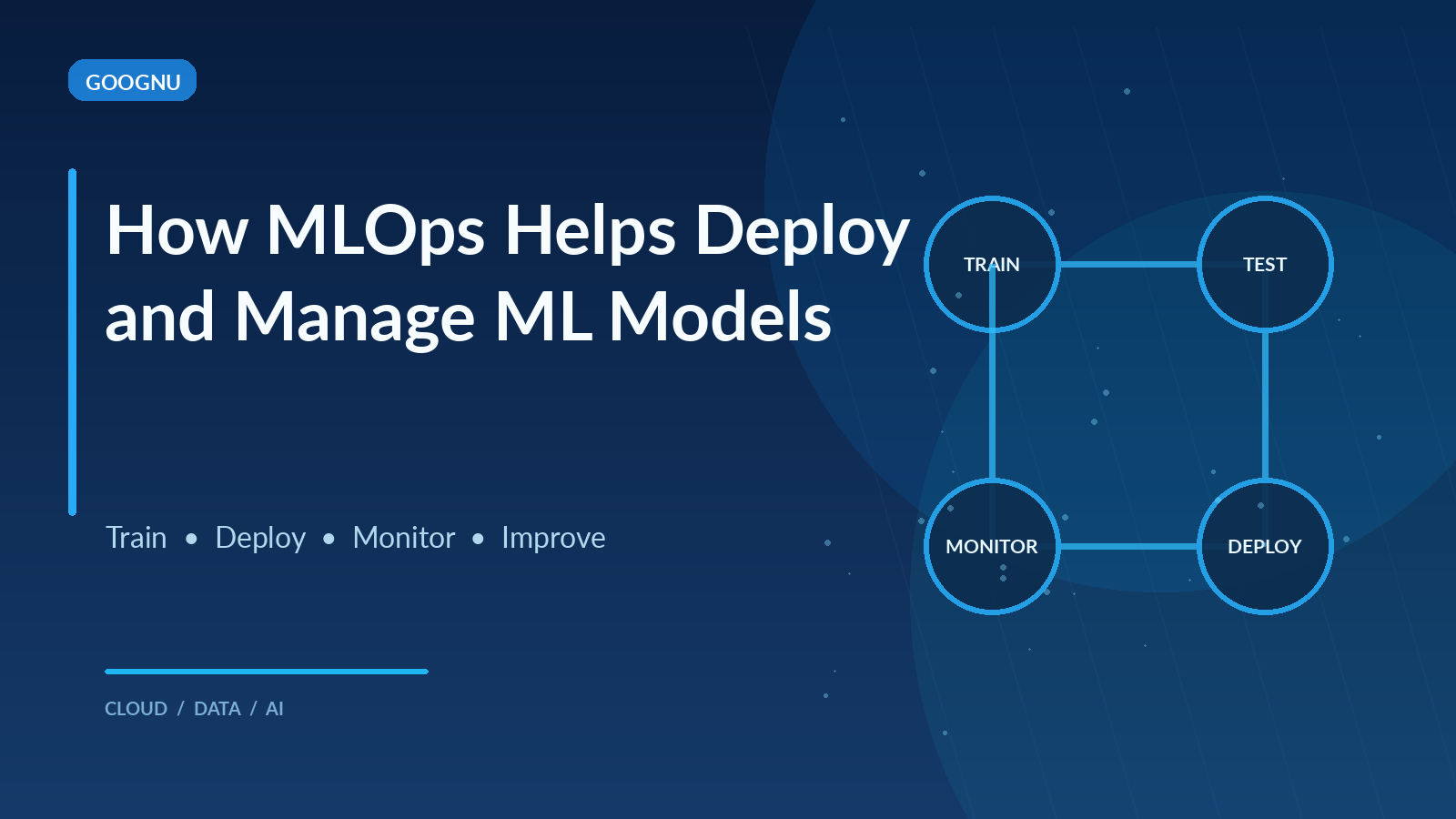
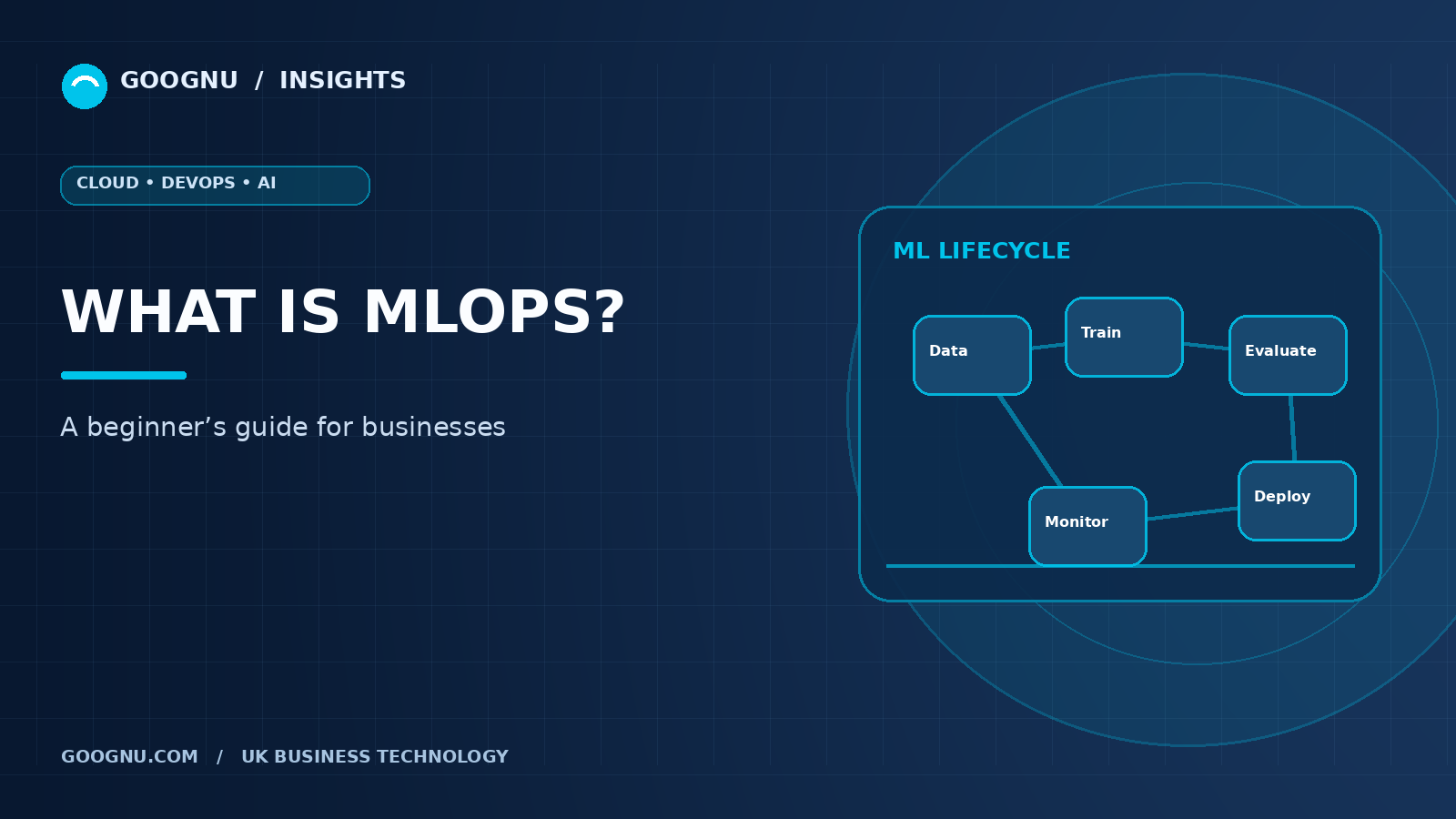
MLOps stands for Machine Learning Operations. It combines machine learning development practices with software engineering and operational processes to help teams manage the complete lifecycle of machine learning models.
Building a model is only one part of a machine learning project. Teams must also prepare data, track experiments, test model performance, deploy models, monitor predictions, and update models when their performance changes.
Without a consistent process, moving a model from experimentation to production can become difficult. Different environments, inconsistent datasets, and manual deployment steps may lead to errors or unreliable results.
MLOps addresses these challenges by introducing repeatable workflows for developing, testing, deploying, and maintaining models.
Common Uses of MLOps
Experiment tracking: Records model versions, training parameters, datasets, and evaluation results so teams can compare experiments.
Model deployment: Helps move trained models into production environments through controlled release processes.
Pipeline automation: Automates repeatable steps such as data preparation, model training, testing, and deployment.
Model monitoring: Tracks prediction quality, latency, and changes in incoming data that may affect model performance.
Model versioning: Maintains records of model versions and supports controlled updates or rollbacks.
MLOps is valuable for businesses that use machine learning in recommendation systems, fraud detection, forecasting, customer analytics, image recognition, or other applications.
Its main purpose is to make machine learning systems easier to develop, release, monitor, and maintain over time.
AIOps vs MLOps: The Main Differences
Although the two practices share some technologies, their objectives and day-to-day responsibilities differ.
1. Primary Objective
AIOps focuses on IT operations. It helps teams understand operational events, identify potential failures, reduce alert overload, and maintain service availability.
MLOps focuses on machine learning operations. It helps data science and engineering teams move models from development into production and manage them throughout their lifecycle.
2. Problems They Solve
AIOps addresses problems such as unexpected application downtime, unusual infrastructure behaviour, repeated alerts, and difficult incident investigations.
MLOps addresses challenges such as inconsistent model training, unreliable deployment processes, model version conflicts, and declining prediction quality.
3. Data They Work With
AIOps commonly analyses operational data, including server metrics, application logs, network events, monitoring alerts, and infrastructure records.
MLOps works with datasets used to train and evaluate models, experiment results, model artefacts, prediction outputs, and monitoring information related to model performance.
4. Teams That Use Them
AIOps is commonly associated with IT operations teams, site reliability engineers, cloud engineers, and infrastructure support teams.
MLOps is generally used by data scientists, machine learning engineers, data engineers, and platform engineering teams responsible for machine learning systems.
5. How Success Is Measured
AIOps performance may be evaluated through incident detection time, mean time to resolution, alert accuracy, service availability, and reductions in manual operational work.
MLOps performance may be measured through deployment frequency, model reliability, reproducibility, prediction latency, and the ability to detect and manage model drift.
The right measurements depend on the business objective and the system being managed.
Can AIOps and MLOps Work Together?
Yes. AIOps and MLOps can support different parts of the same technology environment.
Consider an online business that uses a machine learning model to recommend products to customers. The MLOps process manages model training, testing, deployment, and monitoring. It helps the team identify when incoming data changes or prediction performance declines.
Meanwhile, AIOps can monitor the infrastructure supporting that application. It can help detect rising server utilisation, database delays, network problems, or service interruptions.
Suppose customers begin receiving slow recommendations. MLOps monitoring may show that model prediction latency has increased. AIOps may identify that the underlying server is running out of available memory. Together, these findings help the teams investigate whether the issue comes from the model, the infrastructure, or a combination of factors.
The practices remain distinct, but their combined use can improve visibility across both machine learning applications and the systems that support them.
Tools and Technologies Used in Each Practice
The tools selected for AIOps and MLOps depend on the organisation's existing systems, technical requirements, and preferred infrastructure.
AIOps implementations may use monitoring and observability platforms, log analysis systems, anomaly detection capabilities, event correlation tools, and incident management integrations. These tools collect operational information and help teams identify issues across their environments.
MLOps implementations may use experiment tracking platforms, model registries, workflow orchestration systems, automated testing tools, and model serving platforms. Tools such as MLflow, Kubeflow, and cloud-based machine learning services can support different parts of the model lifecycle.
Some tools may overlap in areas such as monitoring, automation, and data analysis. However, choosing a product should begin with the problem the team needs to solve rather than the number of AI features it offers.
Common Misunderstandings About AIOps and MLOps
Because the names sound similar, businesses sometimes assume that AIOps and MLOps are interchangeable. This can lead to unclear project goals and unsuitable tool choices.
One misconception is that AIOps is simply a platform for developing AI models. In practice, its focus is on applying intelligence to IT operations, even when the underlying models are developed or maintained elsewhere.
Another misconception is that MLOps only concerns deploying a model. It covers a wider process, including experiment tracking, data and model versioning, testing, monitoring, and ongoing maintenance.
It is also important to understand that neither practice guarantees complete automation. Both require suitable data, clear workflows, access controls, and regular review. Human expertise remains essential when systems encounter unfamiliar situations or make recommendations that could affect important services.
How to Choose Between AIOps and MLOps
The choice depends on the challenge your organisation is trying to address.
Choose AIOps when your priority is improving IT monitoring, understanding operational incidents, reducing alert overload, or identifying infrastructure problems more quickly.
Choose MLOps when your priority is building reliable machine learning workflows, deploying models consistently, tracking experiments, or maintaining models after release.
Some organisations will benefit from both. If your business operates machine learning applications in production, MLOps can manage the models while AIOps helps maintain the infrastructure and services those models depend on.
Before adopting either approach, identify the main operational gaps, review the tools already in use, and define measurable outcomes. A focused implementation can help demonstrate value before expanding to more complex workflows.
Frequently Asked Questions
1. What is the main difference between AIOps and MLOps?
AIOps applies AI to IT operations to help detect, investigate, and resolve infrastructure or service issues. MLOps manages the development, deployment, monitoring, and maintenance of machine learning models.
2. Does MLOps use artificial intelligence?
MLOps supports the lifecycle of machine learning models, which may use AI techniques. However, MLOps itself is a set of practices, processes, and tools rather than a specific AI model.
3. Is AIOps useful for cloud management?
Yes. AIOps can help analyse cloud monitoring data, detect unusual resource behaviour, correlate alerts, and support incident investigation across complex environments.
4. Can a company use AIOps without MLOps?
Yes. An organisation can use AIOps to improve IT operations without developing its own machine learning models. Similarly, a business can implement MLOps without using an AIOps platform.
5. Are AIOps and MLOps complementary?
Yes. MLOps helps maintain machine learning models, while AIOps helps manage the IT systems supporting applications and services. Using both can improve visibility across the technology environment.
Final Thoughts
Understanding AIOps vs MLOps starts with recognising that they solve different operational problems. AIOps helps IT teams monitor systems, investigate incidents, and improve service reliability. MLOps helps machine learning teams build repeatable workflows and maintain models in production.
Neither approach replaces the other. Businesses should select the practices that match their immediate needs and consider combining them when both infrastructure operations and machine learning lifecycle management require attention. With clear goals, suitable tools, and proper oversight, both can contribute to more reliable technology operations.